
Worcester City Directory Holdings
The historical shelf is spread across Worcester repositories rather than one uninterrupted run. The Worcester Historical Museum directory collection identifies examples from 1829, 1842-43, many years from 1844 through 1869, and selected later volumes through 1945. Its description includes alphabetical citizens, businesses, street listings, government, schools, societies, churches, post offices, and local material. That breadth makes a volume useful for more than a name search, but it also means a business-only listing should not be read as proof that a person lived at an address.
| Collection | Years shown or covered | Where held | Access route |
|---|---|---|---|
| Worcester annual volumes | 1829; 1842-43; many 1844-69; selected later examples to 1945 | Worcester Historical Museum and Worcester Public Library | Library collection, selected scans, or librarian inquiry |
| City, street, house, and specialized directories | Local holdings vary by title and year | Worcester Historical Museum | Ask the Museum Library about the target year |
| Early printed volumes | National early collection, especially before 1880 | American Antiquarian Society | Repository research |
| Digitized 1880 directory | 1880 | Google Books | Searchable digital text and volume view |
These dates are documented examples, not a promise that every intervening year is online. Ask for a missing year before treating a gap as a missing household. WPL also keeps early twentieth-century Worcester directories in the Main Library Local History area, while its collection reaches beyond Worcester to other Massachusetts cities.
Worcester City Directory Years
Directory form matters. An alphabetical section begins with a name and usually gives an address plus an occupation or business line where printed. A street section reverses the question: start with the street, read the number sequence and compare the surrounding entries. Worcester sources also describe house and specialized directories, so the best volume depends on whether the question concerns a person, a block, a civic body, or a local business name.
Use each volume as a dated publication. It can preserve the spelling supplied to the publisher and the address used for that edition, yet it can contain editorial delays, reporting limits, or an unlisted household. A change between volumes is a lead to test against a census, deed, death notice, map, or probate record, not a final answer.
Note: Modern ZIP codes and present-day parcel labels did not exist in the earliest Worcester volumes, so preserve the directory’s own street wording.
Worcester Local History Collections
Worcester Public Library’s “Where in Worcester?” resource is a practical starting point when a directory entry needs context. It routes local-history questions among the Library, City Clerk, Registry of Deeds, Probate Court, Worcester Historical Museum, American Antiquarian Society, Clark University map library, State Archives, and National Archives. The Library’s databases also list city directories beside census, obituary, newspaper, vital-record, and Sanborn-map resources.
The WPL local-history research inventory identifies the repositories that hold the complementary records.
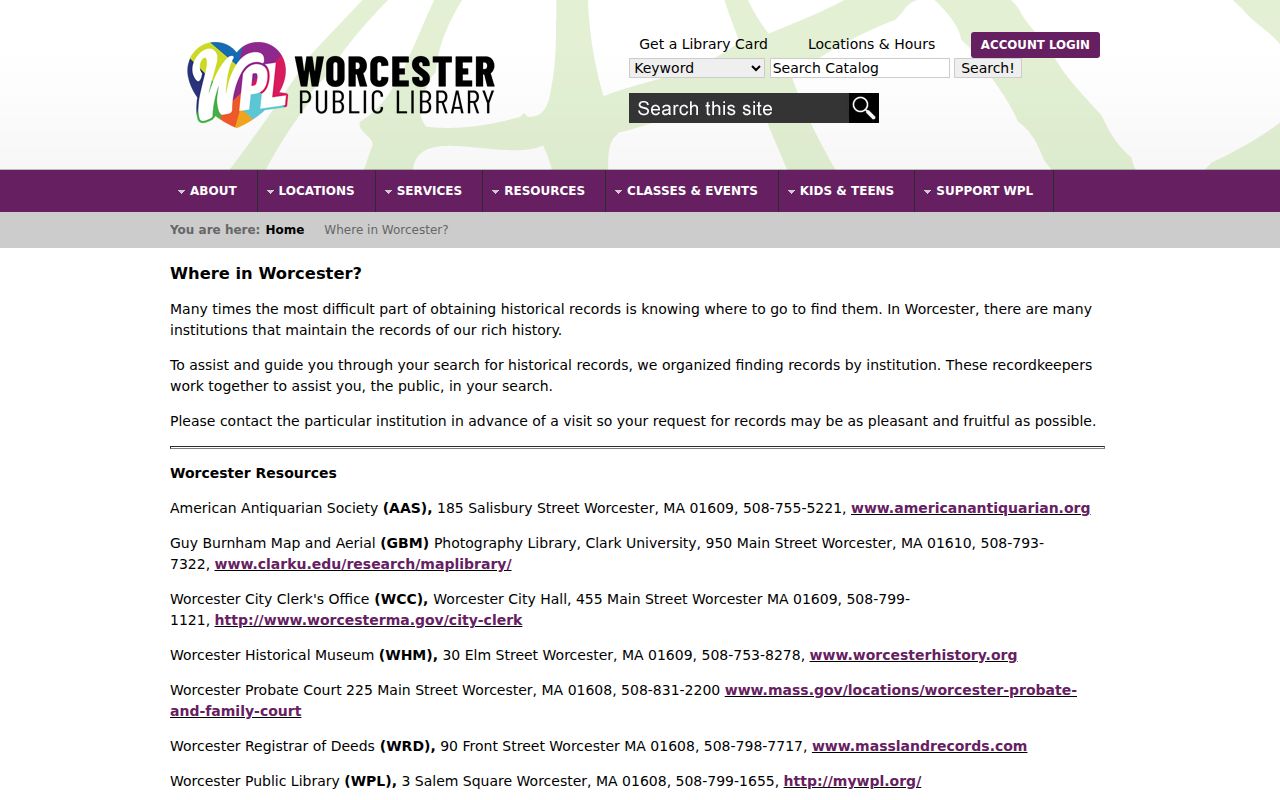
Use that routing list to move from a directory address to the custodian most likely to hold the next record, rather than repeating the same name search in an unrelated system.
For an earlier printed source, the American Antiquarian Society is especially useful before 1880. For a local newspaper or obituary lead, WPL and the Museum have distinct clipping and database holdings. The collection locations differ, so record both the directory year and the repository where a supporting item was found.
Reading a Worcester City Directory Entry
Read every line as a transcription target, not as a biography. The available Worcester research supports an inventory of fields to capture from a real page image. Exact punctuation and abbreviation typography were not verified in a live page capture, so preserve the wording in the volume instead of expanding a shorthand by guesswork. A surname alone is rarely enough when several people share it.
| Alphabetized name | Use the exact spelling, initials, honorific, and any alternate form printed. |
|---|---|
| Address | Record the number, street wording, and any cross-reference in that edition. |
| Occupation or business | Capture it only when printed, along with a business name if the entry gives one. |
| Family notation | Preserve spouse or widow wording if present; do not supply a relationship that is absent. |
| Edition context | Keep the directory year, publisher, page image, and nearby entries for later comparison. |
- Street section
- The part arranged by street and number, useful for comparing an address with nearby printed entries.
- House directory
- A locally held directory organized around houses or addresses; availability depends on year and title.
- Criss-cross directory
- A reverse directory arranged from address toward name. A complete Worcester run was not verified, so ask WPL or WHM about the target year.
- Abbreviation key
- The publisher’s explanation of shorthand. Photograph or transcribe it before interpreting a symbol in an entry.
Worcester Museum Research by Mail
The Worcester Historical Museum Library can add the material a bare listing lacks. Its non-lending collection reports about 7,000 published titles, more than 400,000 photographic prints, and roughly 4,000 linear feet of unpublished documents. Clipping files, photographs, manuscripts, maps, and city documents can help test whether a move, public event, or address label shown in a directory fits the period.
The Museum Library’s research page describes appointment, copying, and mail-research conditions for these collections.

The Museum offers a preliminary free 15-minute search and can handle mail research for a prepaid fee, subject to its current limits. Its published research hours are Wednesday through Saturday, 10 to 4, by appointment. Fragile material and copying remain under staff control.
This is a practical route for a relative, classmate, or family-history question when the directory creates a lead but the next document is not digitized. The scale of the Museum collection also reminds a researcher that Worcester’s historical evidence reaches well beyond the few scans visible online.
Worcester Directory Milestones
The documented directory examples fit into Worcester’s changing record landscape. Worcester became a city in 1848, while municipal city vital series begin that year and the Registry’s land record trail begins much earlier, in 1731. Pairing a directory with the correct custodian keeps a nineteenth-century address from being forced into a modern search form.
- 1829: a Worcester directory example is identified in the Museum collection.
- 1842-43: another documented directory spans the years just before city incorporation.
- 1844-69: the Museum lists many directory years across the city’s early decades.
- 1880 and later: a digitized 1880 volume is available, while the Museum identifies selected examples through 1945.
This timeline is a collection guide, not a complete publishing history. Contact the holding repository for a year not listed in its online description.
Tracing Worcester City Directory Households
Follow one name in both directions, then test the changes. Start with the first edition that plausibly fits the person and capture the complete entry. Move to the nearest earlier and later directory, keeping a separate note for every address, name form, and printed family or business notation. The street section can then show how the publisher arranged the address and its immediate surroundings in that year.
- Normalize the historic street spelling and number without adding a modern ZIP code to the old entry.
- Find the person in the alphabetical section and preserve the exact page wording.
- Read the street section for the same address, number sequence, nearby institutions, and neighboring listings.
- Compare the next and previous available editions, noting a move, name change, or directory gap.
- Pair the dated listing with census, deed, probate, map, newspaper, or obituary evidence that matches the question.
A disappearance can reflect a move, death, a change of household head, a changed spelling, an unlisted person, or a gap in the available volumes. For a modern parcel-oriented question, use the current records on the Worcester streets directory rather than asking a historical volume to establish present residence.
Worcester City Directory Cautions
Directory evidence is strongest when its date and scope are kept visible. A published address can support a historical listing for that edition. It does not by itself prove ownership, current presence, a family relationship, or the reason a person vanished from the next volume. Compare a deed when the issue is a recorded transfer, a vital record when the issue is a recorded event, and a map when a street pattern does not line up.
Worcester’s directories, maps, parcel records, wards, precincts, and postal labels are different systems. Record the source year beside each label. That comparison avoids treating a historical street listing as if it were a current parcel card or a postal address.
Note: Ask the custodian about missing years, reproduction rules, and access conditions before relying on a scan or ordering copies.