
Worcester Previous-Resident Sources
Previous residents are best traced as a dated sequence. Worcester's assessor card supplies the current parcel identifier and an owner-of-record lead. The Registry then supplies land instruments, while directories, maps, newspapers, and public historical collections add household and address context. These sources have different coverage and meanings. A current owner field is not proof of a current occupant, and a directory listing only supports the year printed or reported by that publication.
| Source | Years It Covers | Where Held | What It Shows |
|---|---|---|---|
| Worcester Registry land records | 1731-present | Registry and MassLandRecords | Deeds, mortgages, liens, plans, and other land instruments. |
| Fully indexed land records | 1960-present | MassLandRecords | Name, document, book/page, property, recorded date, and image routes. |
| Grantor/grantee index books | Before 1960 | MassLandRecords | Surname-to-book/page starting point for older transfers. |
| Worcester city directories | 1829 onward, with documented gaps/examples | WHM, WPL, selected scans | Person, address, year, and street context. |
| Maps and atlases | 1683-present described by WHM | WHM, WPL, Clark | Street layout, lots, buildings, and name changes. |
| Census and tax lists | Federal census; local historical transcriptions | WHM, WPL, NARA | Household, tax-district, and residence context. |
| City vital series | 1848-present | Worcester City Clerk | Recorded city birth, marriage, death, and municipal series. |
| State Archives vital holdings | 1841-1935 | Massachusetts State Archives | Historical index and certified-record route. |
Start with the era you are trying to place. A recent transfer normally begins with the current parcel and an online Registry result. A nineteenth-century address often needs a directory, map, and index-book surname search before it yields a deed image. The Worcester Property Records page is the practical current-address starting point because it accepts MBL, street name, and owner name.
Worcester Previous Land Eras
Worcester's land trail reaches back to 1731, much earlier than the modern assessor portal. That depth is valuable, but it also changes the method. The Registry's land history moves from older handwritten instruments and local town or county context to the city-era combination of directories, maps, and municipal records. For the twentieth century, the index-book method remains important before fuller online land indexing begins in 1960.
Keep the era beside every result. A recorded date, directory publication year, census enumeration date, assessment year, permit issue date, and newspaper date are not interchangeable. They can support a useful address timeline when each line names its source and date. Note: a deed recorded in a year may describe a transfer made earlier, so read the instrument rather than relying on the search-result date alone.
Worcester Pre-1960 Index Quirk
The Registry's unusual but well-documented older workflow is the key local quirk for previous residents. Before January 1, 1960, online access is chiefly through scanned grantor and grantee index books. A modern address search can therefore fail even when an older transfer exists. Search a surname and year range, inspect the index page and arrows, record the book and page, then use the Unindexed Property Search route to reach the scanned instrument.
Check initials, alternate spellings, married names, corporate trustees, and estate representatives. Supplemental Surveyor Indices cover listed blocks from 1731 through 1973 and can provide another historic property lead. The Registry's own instructions distinguish this process from the fuller post-1960 search.
The Worcester Registry search instructions show the grantor/grantee and unindexed-property sequence.
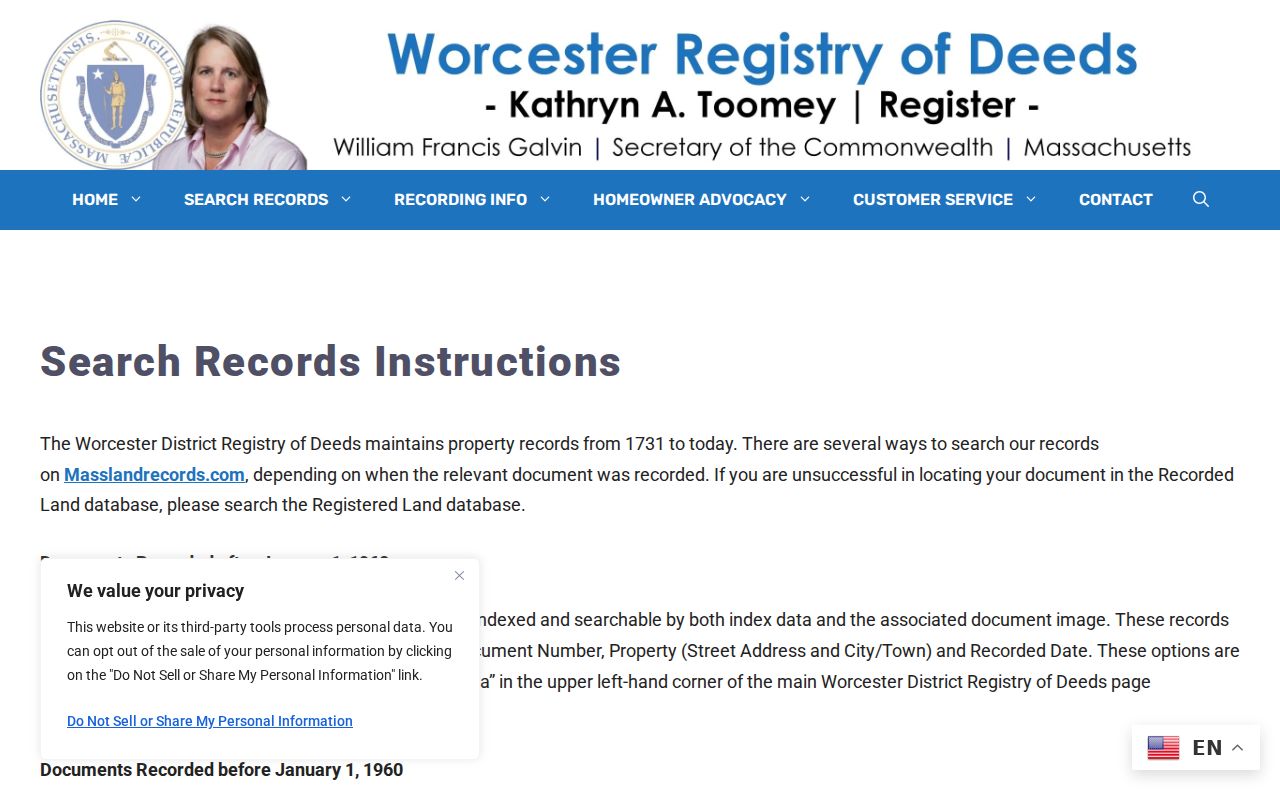
The instructions make clear why an older address trail may begin with a name in an index book rather than a street-address result.
Trace Worcester Previous Owners
For a Worcester address, begin with the assessor result and write down the MBL, situs address, owner name, assessment-year fields, and any deed book/page or document reference that appears. The situs is the parcel's physical location. A mailing address can be elsewhere and is not evidence that its recipient lived at the parcel. For formal ownership confirmation, the city describes a certified assessor inquiry; recorded deeds remain the Registry's record.
- Search the Registry's post-1960 property or address route for the latest land instrument.
- Read the deed itself. The grantee is the party receiving the transfer, and the grantor is the party conveying it.
- Search that prior grantor as a grantee in an earlier period, then compare the description, dates, and parcel references.
- Repeat the sequence backward, keeping the instrument type and recorded date beside each line.
- When the trail reaches the earlier era, move to the surname index books, book/page, and Unindexed Property Search rather than concluding there was no transfer.
- Grantor / grantee
- The transferor and recipient named in a recorded instrument. Their roles apply to that instrument, not necessarily to every later property record.
- Chain of title
- A documented sequence of land transfers for the same described property, checked one instrument at a time.
- Legal description
- The lot, plan, boundary, unit, or other property wording in the instrument. It can remain more stable than a street number.
- Situs address
- The parcel's physical address, distinct from an owner mailing address used for tax correspondence.
Worcester Previous Deed Dates
Not every item in a Registry result advances a chain of title. Mortgages and releases can appear between ownership transfers. A quitclaim, administrator's deed, foreclosure deed, tax title, probate decree, condominium declaration, easement, or plan can answer a property question without being the next owner deed. Read the document type and the party role before adding a line to an address history.
| Date on a timeline | What it usually records | Careful use |
|---|---|---|
| Deed recorded date | Registry filing date | Check the instrument for execution and transfer details. |
| Directory publication year | Year of the printed address snapshot | Do not treat it as continuous occupancy. |
| Census enumeration date | Date tied to the federal schedule | Use it as a household-era check. |
| Assessment year | Fiscal parcel valuation context | It is not a sale price or move date. |
| Permit issue date | Publicly recorded permit activity | The issued-to name does not establish ownership or occupancy. |
If a property was split, merged, or converted to a unit, follow the plan reference and legal description. A name match and a modern street number alone can join the wrong property history. This comparison of dates and record roles is often what separates a sound past-resident trail from a list of unrelated names.
Worcester Previous Household Timeline
Deed parties are only part of the address story. Worcester city and street directories can place a person at a printed address in a particular year, and census, tax, newspaper, and map evidence can test that placement. The research did not establish a complete separate local criss-cross run, so use the verified street-directory section and ask Worcester Public Library or Worcester Historical Museum whether a house, specialized, telephone, or reverse directory survives for the target year.
- Normalize the modern address, then record the historic spelling, number, suffix, and nearby corner found in the directory or map.
- Read the directory's alphabetical and street sections, preserving the exact name and address line.
- Place the directory year beside the closest useful census or local tax-list evidence without claiming they were collected on the same day.
- Compare the street order and building footprint in a Sanborn map, atlas, or aerial source.
- Use a deed, probate file, newspaper, or clipping only for the fact it supports, then mark conflicts for follow-up.
The historical collections themselves have their own depth and access conditions. The Worcester city directory collections are the better route for locating a particular printed year, while this address trail keeps the focus on placing that entry in time.
Worcester Previous Probate Checks
A deed gap does not prove a missing property history. Transfers through an estate, foreclosure, trust, merger, or parcel change can interrupt the normal grantor-to-grantee pattern. For an estate-related gap, search the decedent and fiduciary names in the Registry and check Worcester Probate and Family Court. Estate inventories, petitions, fiduciary appointments, and decrees can explain why a normal deed sequence is absent, although some probate material is confidential or impounded.
MassCourts, courthouse public terminals, the clerk or registry, and the Probate virtual registry are distinct access channels. Historical questions can also need WPL, WHM, State Archives, or newspaper indexes. A request should identify the address or person, approximate years, record type, and the desired electronic format. Note: a probate explanation can clarify a transfer without making every probate document public.
MassCourts public eAccess is the online starting channel for a public probate docket, while the local registry and court terminals can have different access to the actual file.
Worcester Past Resident Evidence
Worcester Historical Museum and Worcester Public Library are the useful handoff once a deed chain has reached a historical address. WHM describes city, house, and specialized directories, clipping files, maps, photographs, manuscripts, and city documents. WPL has early twentieth-century city directories, newspapers, Sanborn maps, annual reports, and research databases. Specialized local map collections add map and aerial comparison. Together, these sources can explain a house's changing address, lot form, or household context without assuming every owner lived there.
WHM's non-lending research library accepts appointments Wednesday through Saturday and offers a preliminary free 15-minute search. Its mail research route can provide a paid, limited photocopy search. Ask staff about the target year, street wording, map sheet, and reproduction rules. Use obituaries and newspapers as public reports that may support a move, death notice, association, or house event, then seek the controlling record when proof is required.
Lawful use. Worcester past-resident research is appropriate for family history, house history, estate work, and personal curiosity. Do not use an address trail to harass, monitor, or harm a living person.